
Another Opportunity to Question Our Thinking

It’s wildfire season. Fire prevention has become another multi-layered situation that has me questioning commonly given advice. As I learn new perspectives, my new questions don’t get simple answers. While I notice fire risk’s relationship to soil moisture, air conditioning (it takes water), solar PVs (panels generate more heat than electricity) and data centers (they guzzle water to keep computers cool), I’d welcome forums where we can discuss the complexities respectfully.
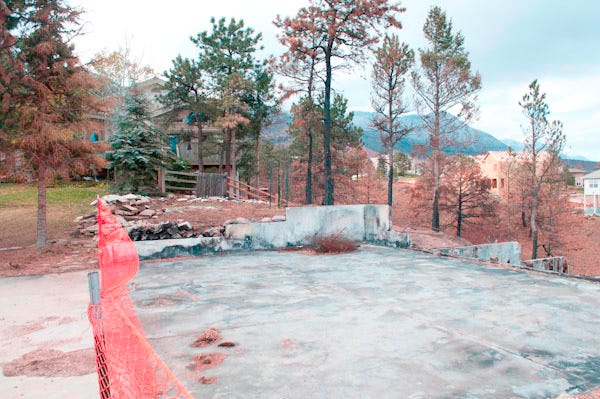
Firefighters typically advise cutting down the trees and shrubs around a house in order to create “defensible space” and reduce fire risk. However, such cutting reduces soil moisture. Ecologist George Wuerthner finds that well-watered urban vegetation can help reduce ignition by reducing heat and, at times, blocking wind-tossed embers from reaching a home. He questions removing adjacent vegetation near homes. Wuerthner’s photos show urban houses burnt to their foundation…while nearby trees remained green. Instead of cutting down trees, he suggests protecting homes with non-burnable roofing, screened vents, cement siding and sprinkler systems.
Gabriel Popkin reports that one tree has the cooling power of about 10 window air conditioners…while solar panels radiate much more heat near their glass covers than they convert to electricity. (I wonder: do solar panels on a flammable roof increase fire hazards?) Popkin questions why anyone would cut down a forest for a solar PV facility.
In 2022, before Dominion Energy’s 4500-acre solar facility took out some 3,500 acres of Virginia forest, Popkin suggested that instead of destroying forests and farms, panels could go on already degraded land—i.e. abandoned industrial sites and landfills.
Natalie Fleming writes that The Mojave Desert is now covered with sprawling solar facilities. She wonders if these solar installations—upwind of Los Angeles— unintentionally heat air and amplify already-destructive Santa Ana winds.
Hart Hagan explains why “tree thinning” is a bad idea even though the Forest Service promotes it. Monday, September 15 at 7pm/Eastern, Hart will offer a free webinar, “The Worldwide Loss of Soil Moisture.” Worldwide, between 2000 and 2016, we lost 2,623 gigatons of water. One gigaton is one billion tons—or one cubic kilometer of water. The Earth’s soils are running dry, and soil organisms are dying of thirst.
Does this dryness relate to data centers’ consumption of water? Tech corporations rarely tell the public exactly how much they use—even while AI will drive an 11-fold rise in data centers’ water consumption by 2028.
As Hart Hagan says, let’s start this conversation!
EVs, WIND, BESS, TOXIC EMISSIONS & DATA CENTERS
Microwave News reports on a study showing that drivers and passengers should beware of “astonishingly high” magnetic fields in electric vehicles.
Offshore wind turbines leak substantial amounts of chemicals/heavy metals in the surrounding waters—and yet their impact on the marine environment has rarely been assessed or monitored. We need to establish cost-effective and integrated monitoring that also assesses noise, electromagnetic fields and habitat impacts.
On Tuesday, September 16th at 1:30pm/Pacific, the EPA will present its findings about the toxic metals and dioxins that spewed from Vistra Corporation’s Moss Landing BESS fire on January 16, 2025. The presentation will take place in Salinas, California at 168 W. Alisal Street. You can join via Zoom at https://montereycty.zoom.us/j/224397747. Never Again Moss Landing’s website also reports that battery energy storage systems (BESS) like the one that exploded last at Moss Landing are popping up all over NY in densely populated communities.
Data centers are also popping up all over. This summer, Microsoft, Google, Amazon and Meta spent more than $100 billion on data center construction. MediaJustice’s new report, The People Say No: Resisting Data Centers in the South, shows how tech corporations are draining the South economically and environmentally—and it offers tools for resisting data centers.
CREATING LIMITS TO TECH
In UK, Tim Arnold created a petition for the legal right to access certain services without a digital device. He writes: “From classrooms to hospitals, from public transport to banking, digital access has become not only the norm but often the requirement. And yet, in every sector of society—education, healthcare, the arts, and even within our own families—we are seeing the emotional, mental, physical and spiritual cost of this transformation…. I’ve started this petition to protect our right to live in a society that values both digital and non-digital ways of life.”
Still in UK, Tories propose that parents should be able to choose a paper and pen alternative—rather than screen-based homework—for their children.
To protect children’s mental health, Madrid, Spain has banned screen-based homework in primary schools and limited at-school computer use to a maximum of two hours each week.
At State University of New York/Oswego, community members can request that the university and its third-party service providers do not use their data for any purpose related to Generative Artificial Intelligence without their explicit consent. Could this form serve as a model for retailers, doctors’ offices and schools?
PALESTINE-ISRAEL
If you love Israel, hold it accountable. Do not buy products whose barcode starts with 729, which indicates that it was produced in Israel. Join the boycott, divestment and sanctions campaign to protest the Israeli genocide of Palestinians in Gaza. Here’s a partial list of Israeli Products. Also, hold the Apple Corporation accountable for its relationship with Israel. Pledge No Apples for Genocide. For an introduction to the Palestinian-Israeli conflict, check out In a dark time, Roethke said, the eye begins to see.
Would you buy me a cup of tea each month and upgrade to a paid subscription?
George Wuerthner (who took the photograph of trees standing after the Waldo Canyon Blaze) sent me this important note: The vegetation that is adjacent to the house is critical. Deciduous trees and shrubs are far more resistant to fire than conifers. So if you have maples, aspen, cottonwood, etc. they are far less likely to burn than pines etc.