
A Confession from Tech Bro Gerry McGovern

While so much of our world collapses, we all look for solutions. Israeli historian Ilan Pappé recently offered another approach. Speaking last month about the Israeli-Palestinian conflict, he said, “There is no need for peace. There is need for decolonization. There is need for transitional justice. And more than anything else, there is need to listen to Palestinians, to hear…their aspirations for the future of Palestine. Start with them. Let them be in the driver’s seat and tell us how they view the future of Palestine.”
I see Pappé calling for a Truth and Reconciliation Commission, a place where healing can begin, a place where we can listen to stories from Palestinians who’ve lost childhood, limbs, family, neighbors, homes and land. A place where Palestinians can begin to dream again for equality and democracy.
While so much of our world collapses, we need many Truth and Reconciliation Commissions.
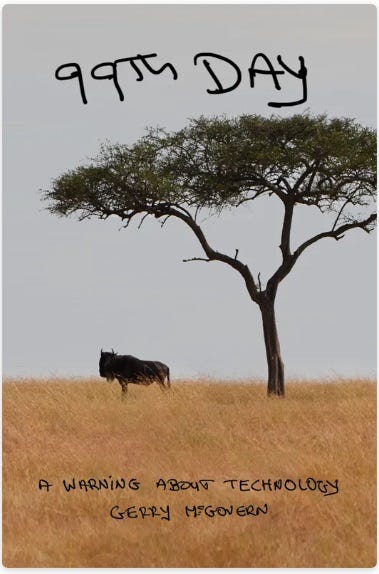
Gerry McGovern’s newest book, 99th Day: A Warning about Technology, reads like a Truth and Reconciliation Commission about technology’s impacts on ecosystems and public health. From his start on a small Irish farm, McGovern wanted to be a modern, materially wealthy man. In the early 90s, he developed an online community, a blogging system and a way to manage web content. He became “an evangelistic tech bro, a booster of ‘renewable’ energy who believed there was no innovation that tech couldn’t solve.” In a blink, he made money, money, money.
Eventually, McGovern learned about the ecological effects of manufacturing, operating and discarding electronic technologies. At the end of his dreamy solar system’s usable life, he realized it’s un-recyclable hazardous waste. (His previous book, World Wide Waste, focuses on the two billion tons of electronic waste we humans generate every year.) While moving to Spain, Gerry discovered that the country’s rains were disappearing—and how mining for electronics contributed to the drought. Through his partly Indigenous Brazilian wife, he began to see the living connections between water, soil, rocks, birds, bees and future generations.
In 99th Day, with refreshing honesty, Gerry McGovern names his part in our techno-sphere’s mess; and then he reports the worldwide consequences of digitalized society. McGovern calls his book a warning. For writing it, we owe him hearty thanks.
I’m honored to post “A Confession,” 99th Day’s first chapter.
Chapter One: A Confession
I was a true believer. A full-throated member of the Growth Death Cult. A super-optimistic, evangelistic tech bro. A booster of “renewable” energy and the “Green” Transition, and the idea there was no problem that tech innovation couldn’t solve.
I came across the World Wide Web back in late 1993 in a small flat in Dublin. The first moment I saw it I had this vision of wagons rolling out West to a new frontier. At that time, I was in my early thirties and drifting. Living in shoddy accommodation and scraping by on part-time work. My partner and I had two young children and I felt this intense pressure to provide. The Web would be my way out.
I had been writing rock ’n’ roll and technology journalism. Mixing interviews with Nick Cave, Sonic Youth, Ice T and Lou Reed with stories about computer-aided design and CD-ROM multimedia might have been exciting, but the life of the freelance journalist, and dreaming-to-be fiction writer, was not an easy one.
Some weeks before I came across the Web, I had interviewed a senior executive at the Irish state agency, the National Software Directorate. I decided to write him a snail mail letter. I knew the Web was a bit too new, so I pitched a report about the rapidly growing multimedia industry, with an add-on focus on this emerging thing called the World Wide Web. Amazingly, he got back and said, yes, let’s do this.
In early 1994, I went to this huge multimedia exhibition and conference in Cannes, France. The CD-ROM was being pushed as the future of everything from games to medicine to education. I went around sniffing out the Web. There wasn’t much sign. However, as the year progressed, the Web surged, and the report focus began to change on a monthly basis. Twelve months later, I returned to Cannes and the Web was everywhere. I listened to fevered voices talk about doing all-nighters and lining up finance.
Then I went to Geneva to a packed International Telecoms Union conference. I had a tiny budget and couldn’t afford a hotel, so I slept in a toilet at the airport. I watched bleary-eyed as someone made one of the first phone calls over the Internet. The senior telecom executives sat there horrified. The wave was gathering.
In 1995, my report, ‘Ireland: the Digital Age, the Internet’, was published:
While there is enormous hype surrounding the Digital Age and while it will be a number of years before all the problems and issues are ironed out, there is little doubt but that we are entering a period of fundamental change for society and business. A central engine of this change will be the Internet and for that reason it is the focus of this report.
Meanwhile, I had helped set up a company called Nua, which means “new” in Irish. We had developed this online community / social media idea called Local Ireland. We had also developed a blogging system and the first publication was called Nua Internet Surveys, which tracked surveys and reports on the emerging Web. It was a big success and got us lots of international exposure.
Local Ireland was harder going. It was about creating a platform to allow communities to tell their own story on the Web with simple tools and a unified geographic and classification structure. I heard about an intended trip by US President Bill Clinton to Ireland, and that he planned to visit his relatives in Roslea, County Fermanagh. I drove there in a heavy, smoking diesel car. Every time it had to go up a hill it seemed like it was choking and about to belch out its last breath. I arrived at the Roslea Community Centre and bounded in, thinking I was the bringer of the Good News. The community organizer thought I was mad and said he’d tell me nothing about Roslea for this Web thing, and he certainly would not tell me where the Clintons’ relatives lived.
I walked back out, thinking what an awful fool I was, wondering how on earth I was going to pay next month’s rent. I stood there on a typical grey Irish day. A noise made me turn around. There was a group of men digging a grave. I walked over to them and asked did anyone know where Clintons’ relatives lived. One said he did indeed, and proceeded to give me directions. Local Ireland now had a bit of good content and got some international news coverage.
We kept working away at Nua, building tools and creating content. We got some interest from venture capitalists who said they knew princes on Wall Street. It was all very exciting as they laid out fantastic plans. Then, with great suddenness, they switched from laughing and joking to sneering, telling us we had nothing, demanding a huge share in the company. We declined. Even though we had no paying work, we doubled down on our efforts to build more stuff.
I came across this notification from the European Union about a competition for Internet innovation. Applications had to be sent in by fax. I got ours ready and tried to send it. The line was constantly busy. I got pissed off, grabbed the application, crumpled it up and threw it in the bin. I went out for a walk. Later, when I came back, I noticed the crumpled application. I pulled it out, smoothed it as much as I could. It went through on first try, not that I expected anything from it.
Some months later, I got a call from the European Union saying that it was strongly advised that I should attend a ceremony in Paris. Nua co-founder Niall O’Sullivan and myself went. We were asked to sit at the top row in this huge hall. There were six or so prize categories and we thought that we might have won something in the small business one. It was the first category announced and there were three prize winners. We weren’t among them. I had that outside the Roslea Community Centre feeling. My confused mind tried to figure out where we might have won something. By the final category, we were totally deflated. It was for the Best Overall World Wide Web Business Achievement Award. We knew we had no chance. I can’t remember who came third, but I do remember that the giant multinational, Siemens, came second. Then the award for what the announcer said was the most innovative and forward-thinking Web business in Europe that year was going to … Nua, this tiny Irish company with no money and no customers. It was 1996.
The rollercoaster was picking up speed. We got some good investment, and support from the likes of Ossie Kilkenny, who used to be U2’s accountant. Telecom Eireann, the Irish national telecoms company, got interested in Local Ireland, and millions flowed in. We were regularly in New York and Silicon Valley. We were flying high. Business plans. Business plans. We had good ideas, though the software needed a lot of work. We went around New York peddling an amazing demo for a luxury online jewelry store. Faking it to make it. Money. Money. Money. We even had our very own data center. Expansion. Expansion. Expansion. Big salaries, US senior executives recruited, top New York investment firms courting us. These smartest guys in the room thought we were brilliant. The business plans were being weighed, not read. We didn’t have enough pages in them, we were told. We needed to be more ambitious and seek to open offices in all major European countries within 18 months, we were told. That’s the way it was done. Move super-fast, break whatever you needed to; the winner takes all. Speed is a trip. Don’t think. Just do. Crazy stuff. We were valued at close to what Ireland’s national airline was valued at, and I thought that was crazy. It didn’t make sense. But greed had got in my eyes.
Then, around 2000, the dot com bubble began to fizzle. I went from one frenzy to another, dragged to the bottom, feeling it all crash. Sneaking out the back of the building to avoid the TV cameras at the front. Blood dripping from our gold-plated Nua logo on magazine covers. The sickening feeling of standing before a room full of worried staff and telling them it was all over.
Rising again, this time more slowly. Getting good book deals to explain how to manage all this Web content. Workshop and talk invites flowing in, particularly from Big Tech companies. Traveling the world, usually in business class. Sometimes, a different city every day of the week. Nonstop, thrilling. Explaining user experience, Web content best practice, and the move from organizational centricity to customer centricity. No, customer centricity wasn’t enough according to that visionary of visionaries, Jeff Bezos of Amazon.com. What you needed was customer obsession. “Obsession”, that’s a funny word, a voice in the back of my head whispered.
I was too busy making money to think too much about morality and ethics, though I had convinced myself that I was doing the right thing. Making it easy for people to find things and do things on the Web surely was inherently a good thing, wasn’t it?
Then one day, I read a story about how Amazon was parking ambulances outside their super-hot and unsafe warehouse. That couldn’t be true, I thought, as I prepared another Customer Obsession presentation. I read about Amazon workers being so stressed for time that they were forced to pee in bottles. I heard about Amazon workers getting injured far more often than the industry average. Something was wrong, wasn’t it? Housekeeper staff at a Bezos mansion were being forced to work 14-hour days without a break and with no access to toilets. Staff had to climb out a window to get to a toilet because Bezos had dictated that neither he nor his guests should have to see any of them. I finally realized that you could fill a book with the petty meanness and sadistic cruelty of Jeff Bezos. This was someone I had admired as a Web visionary, whose ideas I was making a good living out of. This was the guy touting customer obsession, and I had thought that was the ultimate expression of a new and better society. A less hierarchical society that was more focused on people’s needs. It was all about focusing on the customer, wasn’t it? A good user experience. Making it easier to consume. We in the user-experience profession felt that the nirvana of our philosophy was expressed in the phrase “Don’t make me think”. Frictionless capitalism. What could go wrong?
Greta Thunberg sat down and protested. I was so struck by her. I thought she was amazing. (Today, I think she is even more amazing.) I considered myself an environmentalist of sorts. When I bought a very large house beside the Irish Sea in 2010—a house much bigger than I needed—I had installed solar energy and a heat pump. I shared a common philosophy in the tech community—that if you use something green, clean, renewable and sustainable, then you can use as much as you want.
I started having problems with my solar. Part of it fell off and smashed on the concrete floor outside our house. It didn’t look good, all this shiny, colored dust and glass and metal. Where would I dump this? I needed repairs too. And so began a journey that took more than a year. The company that had sold me it had been taken over. No, they couldn’t repair, the new company said. I needed to buy a new one. But the one I had was still working. It just needed new parts to bring it back up to full capacity. Company after company I rang. Nothing doing. Finally, I realized this industry does not do repair. It’s install or nothing.
After 10 years of use, my heat pump, which was the size of about two fridge-freezers, started playing up. Couldn’t be repaired either. I was left with a great hunk of metal, plastics, piping, and all sorts of electronics and other stuff, that needed to be taken away and dumped somewhere. It didn’t seem right. Wasn’t this solar and heat pump stuff all supposed to be part of a brave new world of green sustainability and clean renewability?
Two wise women taught me how to love wearing warm caps inside again. I was having an online chat with Viki Harvey, an expert in reducing data waste, and she was wearing a warm cap. In all the thousands of online meetings I have had, I could not remember someone else doing that. Then I was telling Wiep Hamstra, someone who does incredible work on improving online government services, that I was going to buy solar panels for our apartment. She said she was not installing solar. She was wearing warmer clothes, reducing the heat as much as possible, shutting off heat in rooms that weren’t being used.
“It’s a crisis. Act like it’s a crisis,” Greta said, or something like that. That phrase kept repeating itself in my head. I needed to do something more. I had earned enough money to buy back some conscience. What could I do? I was working in digital, the land of the Cloud, this ethereal, dematerialized place, this place of clean energy and green software, so I didn’t think there was much to find.
I began research that would lead to the publication of my book, World Wide Waste, in 2020. If I was truly honest, I always had these niggling doubts about digital. I had worked with data and content for over 20 years at that stage and knew full well that most data was created for no useful purpose and was stored for no useful reason. Most intranets and websites were data dumps. Most software was awful: poorly written voluminous code piled on top of poorly written, voluminous, badly maintained code. Most digital projects went nowhere. All those apps that were developed, hardly anyone ever used them. Waste everywhere you looked. So that became a key theme of the book: reducing digital waste.
All of that got blown out of the water by the surging Bitcoin and AI, of course. Or did it? We now take more photos in one year that we took in the entire 20th century. By the early 2020s, over 10 trillion photos were being stored in the Cloud, the vast majority of which would never be accessed again. We send incredible quantities of emails, create enormous quantities of documents and files. We make videos of the most trivial of things. And on and on. The vast majority of this digital stuff should never have been created in the first place and certainly has no good reason to be stored. Every file, image, video requires materials, energy, water.
As the digital problems we face meta-size—jump, jump, jump—we have found a weird way of not dealing with them. We’re not going to deal with our text email problem because—why bother?—images are a far bigger problem. We’re not going to deal with our images and photos problem because—why bother?—videos are a far bigger problem. We’re not going to deal with our videos problem because—why bother?—Bitcoin is a far bigger problem. We’re not going to deal with our Bitcoin problem because—why bother?—AI is a far bigger problem. In digital, we feel no moral compunction to clean up the previous mess we’ve made because Big Tech is always making a newer, much bigger mess to worry about. And deep down there is this belief that there is a new tech innovation coming that will clean up all the messes for us.
I had brought the same basic tech philosophy to bear about what I now know are fake renewables. They were this wonderful get-out-of-jail-free card. It’s an energy production problem, I told myself. Here’s this new energy innovation that’s renewable, sustainable, clean and green. Except I discovered that it’s not even remotely true. Like that broken glass, twisted metal and strange colored dust from my solar energy system, all this “renewable” stuff is incredibly material intense and toxic. It has huge impacts on nature and indigenous communities.
I began to hear from Indigenous people about Green Colonialism and how their lands had been chosen as Green Sacrifice Zones for the mining of green metals and the placement of wind turbines and solar panels. As I read report after report and found example after example of the devastation all this fake renewable energy was doing, my worldview began to turn. This couldn’t be, I thought. This stuff is supposed to be green, isn’t it? We can consume as much as we want, once it’s green, can’t we? All these huge AI data centers are no problem at all once they’re using renewable energy, aren’t they? That’s how I thought and I know that’s how most of the colleagues I knew in digital thought.
As I raised these new uncomfortable truths, that digital was indeed physical, the response of most was initially disbelief. People would look at me skeptically. When I’d explain that the phone they had in their hand had 60 or more materials, that the mining of those materials caused serious quantities of CO2 and major quantities of toxic mining waste, most shook their heads.
Soon, I began to get pushback. It wasn’t that green software was actually “green”, I was told. Nor that clean nuclear, hydro, solar or wind energy were “clean”, “renewable” or “sustainable”. I needed to understand relativity. Relative to coal, relative to oil and gas, all these things were green. This new energy tech reduces CO2—and reducing CO2 is the only thing that matters. And anyone that opposed “renewables” was “shilling for the oil companies”, I was told. What we desperately needed was a massive acceleration in the mining, manufacture and rollout of all these wonderful life-saving technologies. We needed to move fast, and if we broke some things along the way that was okay, because the sunny uplands of the Green Transition awaited the adventurous and the brave who were willing to embrace change rather than resist it. Yet the stubborn facts show that—even if this tech was truly renewable—it wouldn’t matter because there is no energy transition. There never was one in history and there never will be. It’s always been more coal, oil, gas, wood, hydro, nuclear, solar, wind. More. More. More.
CO2 is one card in a 52-card deck of pollution and poison. And yet reducing it is being held up as the answer to everything. We can kill more fish, destroy more forests, wipe out the Andes ecosystem, dump more nuclear poison in Navajo and Hopi reservations, basically do whatever damage we want, once we can pretend—for most often it is pretending—that we’re reducing CO2 with our fake renewables.
We refuse to face the real problem. We consume vastly too much. We waste vastly too much. The material demands from our advanced civilizations will soon be causing a Mount Everest of mining waste every year. And that, I learned, is where the truest of the true story lies. If you want to see the future of a civilization, don’t go to its great buildings to talk to its great men. Instead, walk among its dumps, particularly its mining dumps. There you will see the future written large. For you will always find the clearest and most honest story among the stuff that we throw away. There you will come to know that collapse is coming. It’s only a matter of time.
The Scientific Revolution. It was great, wasn’t it? Didn’t depend on the massive destruction of nature, not at all. And that wonderful Green Revolution that flowed from it? I grew up on a small farm with no tractor. My father used to cut hay by hand with a scythe. I spent long days walking up and down fields, turning rows of hay with a fork, chasing some rare Irish sun. That ‘10-10-20’ brand of fertilizer we got, and that my father spread on the fields by hand from a bucket, that was magic stuff. It quadrupled the amount of hay we got from a field. And when the neighbor’s tractor roared in through the gap—doing us a favor—that was magic too. Jack Flood did the work in 20 minutes that would take us a day. We never thought about nitrogen and phosphorus overload and slurries damaging rivers and killing fish. We never thought about soil degradation through constant use and monoculture crops. We never thought about killing the birds and wild animals because we ripped up their homes in the hedges to make bigger, neater fields. Those bigger fields were easier for the ever-heavier tractors whose wheels were compacting the degrading soil and killing the life below, along with the liberal use of pesticides and herbicides. This was all wonderful progress delivered by the Green Revolution. I mean, who could be opposed to something that’s called “green”?
I so longed to be away from that small farm where we had to depend on the modern farmers around us for handouts from the table of technology. Bringing in the hay with an ass and cart was fun in a certain sort of way, once I could hide the humiliation. Wearing the same worn out clothes year after year, I so wanted to be a modern man who was materially wealthy. When I made it, I promised myself, I would buy the very latest and greatest and most innovative.
And I was true to my word. Once I made it, I changed my computer set-up every two years. Because so little in tech was standardized, that often meant new cables, docking stations, and why not the latest, biggest “energy-efficient” screen? I had a large closet piled full of computer stuff that became invisible as soon as I closed the door. Around then, I had an African couple that used to clean the house. They told me that they were quitting because they were setting up a new business. They were going to export back to Africa second-hand electronics to support schools and small businesses. What a wonderful idea, I thought, and opened up the closet and let them take everything in it.
The first real digital horror I discovered during my research for World Wide Waste was e-waste—the fastest growing waste stream in the world, and extremely toxic. And the Global North was dumping huge quantities in the Global South, pretending it was for schools and such. Those cables I had given were likely going to be added to a huge pile in a poor neighborhood and set on fire by schoolchildren, who would breathe in their toxic air as they poked and stirred, searching for the useful metals that they would sell for the price of a day’s food, if they were lucky.
E-waste is bad, scientist Josh Lepawsky told me, but it’s nothing compared to the damage mining waste does, hidden among wild nature, in poor and indigenous communities, mainly in the Global South. And so began my journey of documenting some of the horrors of mining. I started off in Ireland, where I lived, expecting to find very little, and discovered the Russian mining oligarch-owned Aughinish Alumina, that had done terrible damage in Limerick.
It was 2022. We were in the process of selling our big house and moving to an apartment in Valencia, Spain. Even then, I hadn’t given up on the hi-tech “renewability” dream. One of the first questions I asked was whether we would be allowed install solar on the communal roof. Arriving in Spain, I decided to dig into its mining history and discovered the Rio Tinto area and the centuries of damage done there. I found Millán Millán and his research on why the Spanish summer rains were disappearing, and how authorities tried to silence him.
My wife, Rosilda, is Brazilian, part-Indigenous. We have often spent time in Brazil, and I used some of it to visit Minas Gerais, the Brazilian state that means “General Mining”. Brumadinho, Bento Rodriques, Mariana, Congonhas—places with toxic mining secrets and barren futures. Inspired by Rosilda, I began to discover more about Indigenous culture. I interviewed Daniel, an Indigenous person who wasn’t supposed to exist in Minas Gerais because white people were sure they had exterminated them all. Daniel told me about the true meaning of being Indigenous. I would come across the same descriptions from Indigenous people all over the world. Indigenous means being truly of the land, staying put and being dedicated to becoming a good ancestor, where you take care of the water, air and soil so that you can lovingly pass something good on to future generations. An Indigenous person sees life everywhere: in the air, soil, rivers, birds, bees, trees. The mountains are alive. The rocks are alive. The mountain is your mother and you’re not going to mine your mother. Everything is deeply connected and loved.
The more I discovered, the more Indigenous protectors I came across, the bleaker the outlook became. Indigenous communities are under so much pressure from mining, from coal, oil, gas. Now it was even worse, as there was a mining frenzy for so-called green metals: aluminum, lithium, nickel, copper, cobalt, rare earths, etc. etc. The harms are accelerating, multiplying. These so-called green metals for so-called renewable energy are an oxymoron, if there ever was one. They may be vital for the construction of solar panels, wind turbines and batteries but there is nothing remotely green or renewable about them. It’s all part of an elaborate con and scam on our environment. We’re being led to believe that if we simply change the energy device and source, we can keep on consuming and that, in fact, not only will our continued consumption not be bad for our environment, it will be good for our environment. Because, the con goes, if we move super-fast and roll out all this so-called clean and green energy tech, we will be able to “transition”—the Green Transition—away from coal, oil and gas. This is a total pipe dream down which oil and gas flows. This is a lie as wide as an open-pit coal mine. In the name of the “Green” Transition and “green” metals, we are accelerating the worst of all worlds: more coal, more oil, more gas, AND hydro, AND nuclear AND solar AND wind. We are accelerating when we should be braking.
The most important thing I discovered while writing this book was not technological. Nor was it material. It was social, cultural. It was obvious once I could see it. There’s a common underlying cause of all this greedy devouring. Macho man. Great men, of whom I had hoped to be one. The stench of power, control, domination. I too wanted to dominate, to compete, to work hard and climb to the top. To be wealthy and have a big car and a big house. So, it was very painful for me to find out that at the bottom of the bottom of causes, it’s not a CO2 problem, not even an overconsumption problem. It’s a greedy man problem. The greedy elite male has gotten way, way, way out of balance. I have met enough of them to know that they will never, ever be satisfied. They will devour everything if they are let. If we don’t bring the male of our species back into balance, everything else we do will be futile. For the engine of destruction has got balls.
As I more deeply explored Indigenous thought, I discovered concepts such as bearing witness and intergenerational struggle. Keeping memories alive over hundreds of years, passing on truths and secrets of how to survive in a particular landscape. Being a good ancestor, after all, means being a long thinker, someone who looks to the future with a sense of care and love. Someone who looks to the past too. A backwards thinker, who longs to commune with all life and materials that have gone before them. Who thinks slowly, acts slowly, is constantly in conversation, and is searching for the solution that is good enough; for the perfect solution is only ever perfect for some. Daniel told me about resistance and being a witness. He urged me to tell their story and when I promised I would, he grabbed my hands and smiled at me with eyes that said: You’ve promised.
Indigenous thought is almost directly opposed to the tech bro Silicon Valley culture I was so much a part of; a valley flooded with lies and deceit. For so long, Silicon Valley has been expert at hiding its true face. It literally hid underground the chemical tanks it needed to make its semiconductors, because it wanted to promote clean tech and green software. When I did workshops for Big Tech, I found bicycle paradises, wooden cutlery, table tennis, all sorts of ethereal, soft stuff. In the meetings, though, the tech bros were impatient. Build. Build. Build. Enough talk. Just do it. They hated meetings. Committees were sneered at. They eulogized the solitary hacker who, fueled with Coca Cola, pizza and Big Macs, stayed up all weekend to hack out some brilliant technical solution in a hundredth the time it would take a sludgy development team to do it. Stories would pass like wildfires about how this or that piece of software was developed in super-quick time. Faking it until you made it—lying through your teeth and stealing data where you could—moving fast and breaking things. What a life!
Good ancestors? Are you joking? The tech bro horizon is at most 18 months to three years, when they’re going to cash out. And literally anything goes—just don’t get caught, and if you do, have a good lawyer. At one stage, a tech bro explained to me that the very best of the very best minds in Silicon Valley were relentlessly focused on “user engagement”. Planned obsolescence was not enough. No, deliberately making products with super-short lives that were really difficult to repair and almost impossible to recycle, that wasn’t profitable enough. A more addictive model was needed.
The Web of all those promises had morphed into the Valley of Pimps and Pushers. That’s the core business of AI: to create functioning addicts that can be sold to advertisers so as to sell more fascism, more trashy planned obsolescence products, and the great wheel of overconsumption keeps on spinning, faster and faster. Accelerating. Accelerating. Energy. We must have more energy! We’ll reopen Three Mile Island and rename it Crane Clean Energy Center. More coal, oil, gas, hydro, solar, wind. More. More. More.
I wasn’t proud of my father. He wasn’t a hard worker. There was no development or progress on our farm, only slow decline. If it were not for my mother’s efforts, we would have been in a bad way. In the end, my father was on his own and he seemed happy that way. He grew most of what he ate. Never took a flight. Never learned to drive. Cycled into his eighties. I was ashamed of him. And now I am ashamed of myself. All that success. Books published. Sought-after speaker. Worked in 40 countries. It felt special sleeping in business class. When I was born, in 1962, Ireland was economically poor and ecologically rich. We are the Irish generation of hard workers who embraced technology and globalization. We’re the generation that did three times more damage to our environment than the previous 8,000 generations combined. And we’re proud of it. We devastated the wild salmon and decimated birdlife and I could go on and on about an Ireland craving to be top of the class in the Growth Death Cult. Growth to me was a religion. Everything was okay once the economy was growing. Infinite growth on a finite planet met impossible-is-nothing optimism. There would only be one winner to take all.
I’m a bad ancestor. I’ve done so much damage. I started out intending to write a history of the evils of mining. Then it became a sort of witness statement. In the end, I found myself out. This is a confession. And a warning about technology.
If we're here for truth and reconciliation, does every person need a place to tell their story--including rich guys? Do each of us need ability and place to respond when we're moved to respond??
I don’t know. Agree with most of what he says, but I’m getting pretty tired of rich guys flying around the world telling us don’t do what I did. Worse, of course, when they say you can’t do what I’m doing.