
Digesting disasters AND cool ideas

I take in the day’s news.
I notice corporations barreling ahead with abandon, become larger, acquiring more utilities, building more data centers, offering more AI-drive products, engaging children at younger and younger ages.
I see no legislation that protects people or wildlife during the manufacture (mining, smelting, energy consumption, water consumption, making and applying chemicals) or operation (radiation emissions, addiction, energy use, water use) of power plants, computers, Internet and telecom infrastructure, AI or its infrastructure, solar PVs, industrial wind turbines, batteries, e-vehicles or gas-powered vehicles.
Okay. Some schools now ban cell phones. Some countries ban social media.
But daily activities become increasingly hard without an electronic interface. I notice my own increasing time-at-screens.
I think: only crises like power outages, floods, earthquakes, urban fires can slow or stop development of technology or capitalism.
If that’s true, then what’s constructive use of anyone’s attention?
Real sustenance starts with food. That means knowing how to grow, cook and preserve food. Nutrient-dense food starts with nutrient-dense soil and healthy water cycles.
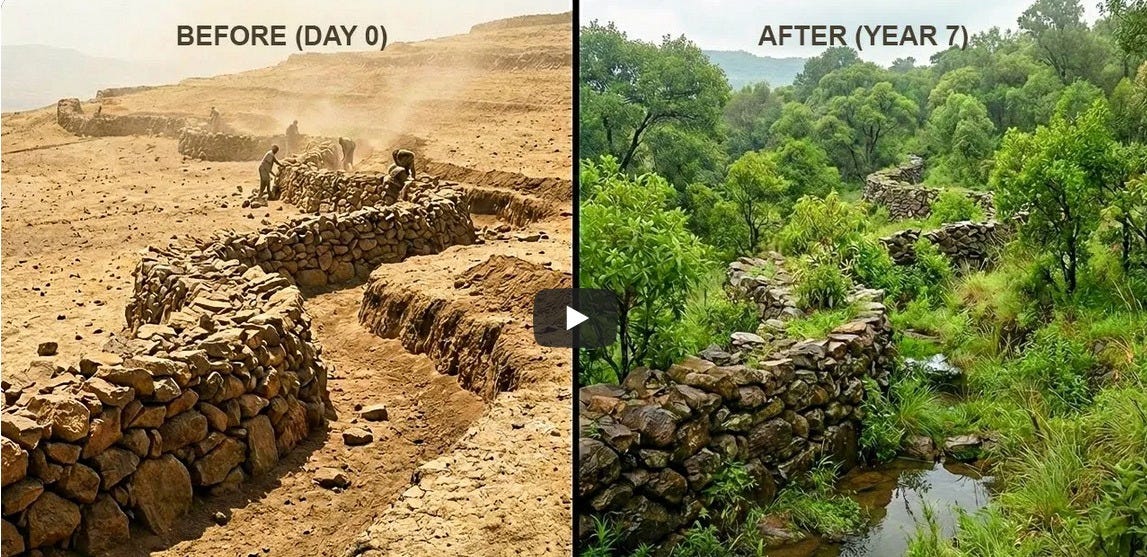
I saw a fantastic video about Ethiopians restoring their region’s healthy water cycles and soil. I post it here with a caveat: I’m pretty that the narrator is an AI.
I don’t see any benefit to ignoring the disasters in our midst.
I also notice lots of people doing wonderful work.
DISASTERS IN THE MAKING
More Perfect Union’s Dan Lieberman reports on Blackstone’s aim to take over New Mexico’s largest utility (PNM)—and ratepayers’ push back against the Public Regulatory Commission. Keep an eye on the relationship between electricity, data centers, water…and profit. Note: I admire New Energy Economy’s Mariel Nanasi’s work enormously. She fights to defend New Mexicans from corporations like Blackstone. However, looked at from their cradles-to-graves, I don’t see anything “renewable” about solar PVs, industrial wind, battery storage or EVs. In fact, we can improve our quality of life without “renewables.”
Christopher Rutledge reports that when mining companies leave, African communities pay. Note the relationship between mining, “clean energy,” ecological ravaging, accountability, public health and human rights protections. Without reliable accountability mechanisms, the clean-energy transition will be neither just nor sustainable. Instead, it will leave behind a trail of abandoned mines, hollowed-out municipalities, contaminated water sources, and displaced families.
Check out this view of data centers’ critical minerals use.
Generative AI consumes—and will consume—significantly more energy than “traditional” AI.
Potomac Sewage Spill becomes ecological disaster and political fight.
The Department of Homeland Security (DHS) is flooding social media companies with subpoenas to identify accounts that protest ICE. Social media companies have pushed back but are largely complying.
Anna Lembke, a professor of psychiatry and addiction medicine at Stanford University’s Addiction Medicine Dual Diagnosis Clinic, says studies conclude that addiction to platforms such as YouTube and Instagram is real and can hurt mental health. Instagram CEO Adam Mosseri told the jury that he does not believe social media addiction is real.
RESTORING LIFE
Here again is a link to Ethiopians “planting rain”—not trees. This water-soil-and-plant restoration project has changed peoples’ attitudes. As one resident says, “We now understand the value of protecting our environment.”
Check out Hugelkultur: An ancient growing method that requires no bagged soil, no fertilizers and almost no watering after the first year—and produces remarkable harvests.
TEN PROPOSALS FOR DIGITAL DE-ESCALATION
1. Secure essential “off-grid” public services.
2. Ensure sober and “de-gafamed” municipal management. GAFAM refers to Google (Alphabet), Apple, Facebook (Meta), Amazon and Microsoft.
3. Guarantee humane public services.
4. Promote jobs, not AI.
5. Ensure security without video surveillance.
6. Ban advertising screens from public spaces and public transport.
7. At schools, promote open and creative education.
8. Combat the “AirBnB-ification” of housing.
9. Refuse the installation of data centers in the municipality.
10. Limit cell towers and electromagnetic exposure.
See also the Manifesto for the Right to Live Without Digital Connectivity.
Grassroots organizers in Wisconsin have a blueprint for beating back data centers. See also Derek Seidman’s report on Truthout about data centers devouring electricity and private equity buying utilities to cash in.
Cities are embracing nature for flood defence, ditching concrete and making space for natural wetlands—from Erica Gies, author of Water Always Wins.
To cool the planet, consider Anastassia Makarieva’s description of the Biotic Pump, mechanisms by which natural forests actively regulate the transport of atmospheric moisture fom the ocean to land.
Rather than distributing basic income, what if people received land? See Manuel Casal Lodeiro’s proposal.
Would you buy me a cup of tea each month and upgrade to paid?
Thanks Katie! Our household especially appreciated the before and after pictures of the Ethiopian greening project. All the other excellent points too.
Yes! Here's a wonderful video report from Millison about a city-wide water restoration project in Bengaluru, India that has had huge impacts: https://youtu.be/jvFk4NsYurA?si=p7XSiISt5cSMEoLt